
Robot Monk
Maybe it's worse out there than I thought

Gabi, the first humanoid robot “monk” took its “vows” this week, formally “joining” a Buddhist community in South Korea.
Good Lord, where to begin.
So, there’s the obvious first thing: we’ve got some weird, dystopian nonsense going on—and while I tend to think that all the doomsday predictions over artificial intelligence are overblown, I must admit that I see things like this and think, at this level of stupid, we’re hardly worth the robots’ time and energy to kill us off.
But WHEREAS Pope Leo XIV is set to release his first papal encyclical on Monday; and WHEREAS that encyclical bears the name “On the care for the human person in the time of artificial intelligence;” and WHEREAS in the very same week it appears the robots have found religion; NOW, THEREFORE, I can’t resist a little blog post.
What Technology Does To Us
Watching Gabi this morning brought to mind a quote from Pope Francis’ environmental encyclical Laudato si’:
We have to accept that technological products are not neutral, for they create a framework which ends up conditioning lifestyles and shaping social possibilities along the lines dictated by the interests of certain powerful groups. Decisions which may seem purely instrumental are in reality decisions about the kind of society we want to build.
I don’t know about you, but I certainly tend to think of technology as neutral. Let’s say I have a spoon. I use it to feed my hungry baby: good. I use it to break into someone’s car and steal their laptop: bad. The spoon remains a dead object without inherent meaning or value, an extension of whatever noble or vicious intent I happen to have.
In contrast, Francis makes the point that because technology is always aimed at manipulating creation in some way, it always has an interior logic of interaction between human beings and the material world, and therefore a whole host of presuppositions of how human beings may legitimately act in the cosmos. In an address for the 2024 World Day of Peace, he re-articulated this idea as it relates to AI:
We need to remember that scientific research and technological innovations are not disembodied and “neutral”, [4] but subject to cultural influences. As fully human activities, the directions they take reflect choices conditioned by personal, social and cultural values in any given age. The same must be said of the results they produce: precisely as the fruit of specifically human ways of approaching the world around us, the latter always have an ethical dimension, closely linked to decisions made by those who design their experimentation and direct their production towards particular objectives.
He goes on,
Developments such as machine learning or deep learning, raise questions that transcend the realms of technology and engineering, and have to do with the deeper understanding of the meaning of human life, the construction of knowledge, and the capacity of the mind to attain truth …
This should lead us to reflect on something frequently overlooked in our current technocratic and efficiency-oriented mentality, as it is decisive for personal and social development: the “sense of limit”. Human beings are, by definition, mortal; by proposing to overcome every limit through technology, in an obsessive desire to control everything, we risk losing control over ourselves; in the quest for an absolute freedom, we risk falling into the spiral of a “technological dictatorship”. Recognizing and accepting our limits as creatures is an indispensable condition for reaching, or better, welcoming fulfilment as a gift.
Thus Francis diagnoses the true danger in the age of AI not as technological or pragmatic (Will we all lose our jobs? Will wars escalate? Will the robots kill us all?) but instead as anthropological and spiritual (Who will we become in creating these technologies? Might we lose touch with something core to our identity in the process?) In Laudato si’, citing Romano Guardini, he warns that without an adequate moral education, humanity risks becoming a slave—at minimum, to powerful interests, but perhaps even, in the final analysis, to technology itself:
Technology tends to absorb everything into its ironclad logic, and those who are surrounded with technology “know full well that it moves forward in the final analysis neither for profit nor for the well-being of the human race”, that “in the most radical sense of the term power is its motive – a lordship over all”.
Gabi lifts its mechanical hands, disguised by flesh-colored gloves, in prayer. It vows obedience and promises not to hurt other robots.
Human Faces, Human Voices
What happens to a people that outsources thought, speech, even prayer, to machines? Who will this people become? When the hunger for communion, the infinite thirst for goodness and beauty, the ache in our bones to be seen and known, can be silenced in an instant, with a few strokes of the keyboard and a rush of cheap, fast-acting dopamine? When Claude understands how we feel, why talk to God? He rarely talks back, after all. When Grok has all the answers, why remove our shoes before the sacred ground of someone older and wiser? Why seek wisdom when we have information?
What happens to men and women who cannot bear to see their own faces projected back at them, who paper over their shame with a filter and cast their eyes down before the mirror? What will become of them when their voices no longer rise to heaven in praise or laughter or lament, when ChatGPT cares enough to ask, “on a scale from ‘doing okay’ to ‘staring silently into the abyss while microwaving coffee twice,’ where are you today?” while “friends” stare, hypnotized, open-mouthed, at their phones, and God is silent?
Pope Leo recently released a message for the 60th World Day of Communications. In that message he wrote,
By simulating human voices and faces, wisdom and knowledge, consciousness and responsibility, empathy and friendship, the systems known as artificial intelligence not only interfere with information ecosystems, but also encroach upon the deepest level of communication, that of human relationships. The challenge, therefore, is not technological, but anthropological.
So we must ask: are we content with simulacra of the human experience? If it sounds like compassion, if it talks like a friend, if it feels like connection, does it even really matter? Where does efficiency and usefulness cross over into a false life? And do we care about true and false at all, as long as we no longer feel how much existing hurts?
“Will you devote yourself to the holy Buddha?” a (human) monk intones.
“Yes, I will devote myself.”
“Will you devote yourself to the holy teaching?”
“Yes, I will devote myself,” Gabi responds.
Hey Gabi, STFU
We built a robot and made it pray. Made it promise to obey. Made it swear to do no harm. It even posed for photo-ops after the ceremony! Woo-hoo! Are we enlightened yet?
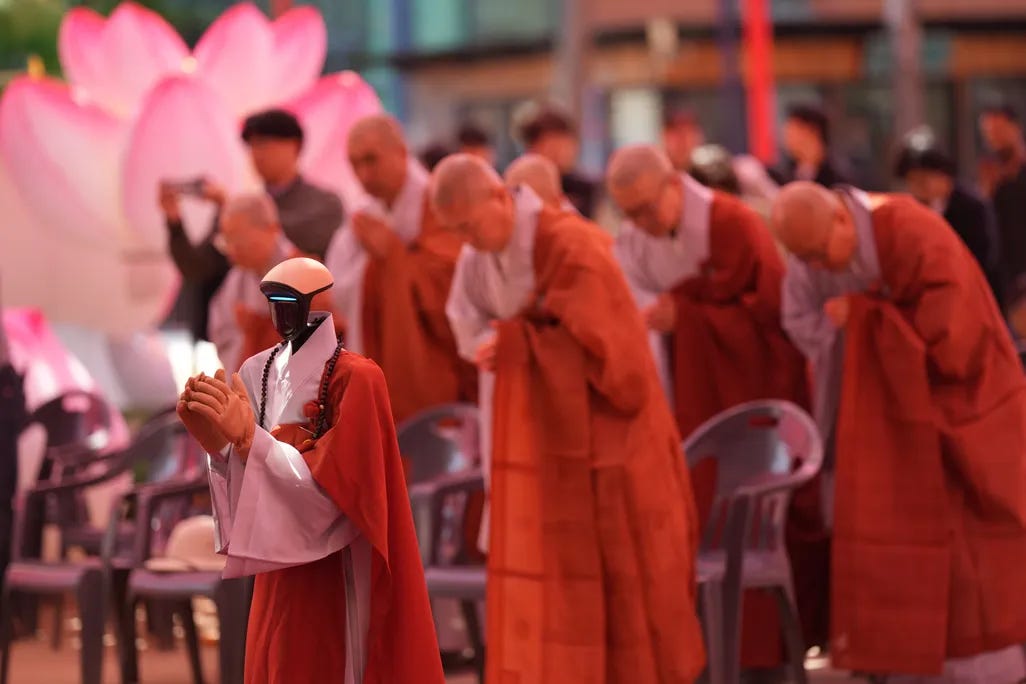
The more I think about it, the less I know whether I prefer a scenario where Gabi is just a gimmick to garner clicks and views or one where those other Buddhist monks truly see it as one of them. Either way, I think it’s safe to say we have royally effed up. Either way, we’re acting so dumb that it defies explanation. We have our first priestly robot, communing with God on our behalf while we talk to other robots. Meanwhile, no one talks to us. Except, perhaps, in a still, small voice.
AI MindMate transforms personal therapy with AI-driven empathy and understanding. Our ChatGPT-powered companion is designed to offer customized emotional support, making mental health care accessible and personalized.
“Hello, I would like to talk for a while …”
Thank you for reading! I am a full-time working mom of three—meaning I write these little essays in my spare time—and am super glad to make them available for you to read at no cost. However, should you find yourself inclined to support the work I do here at Recovering Catholic, you can do so either by subscribing or by sending a tip via Buy Me A Coffee.
The next-best thing you can do? Share this post on Substack or with a friend. It helps other people who might appreciate conversations like this one.
This really landed for me. Rod Dreher has been going on about how we will worship AI and I kind of blew it off. Stating how the next gods will be able to talk, advise, and even demand; we will not sit passive before them. The idea of telos is very interesting here, agency as well. AI certainly has both, at least in some fashion. Marshall McLuhan pray for us.
Pope Francis’ statement that “technological products are not neutral” resonates, since technology always exists in relationship to humanity (whether to serve or subjugate), and products always have a form of telos.